
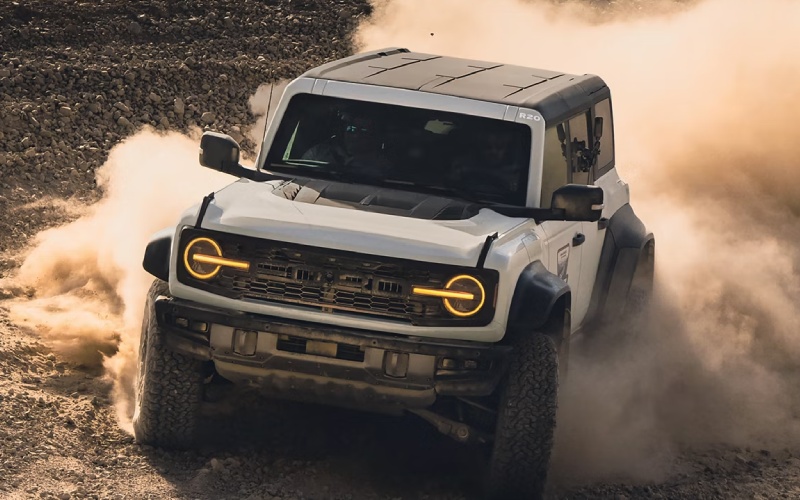
Lake Hartwell Ford – Which SUV brings more factory off-road hardware for weekend trails near Elberton, GA: 2026 Ford Bronco or Toyota 4Runner?
Shoppers often ask a simple question that leads to the heart of their decision: which SUV arrives from the factory better equipped for real off-road use, Bronco® or 4Runner? Around Elberton, GA, that answer should account for the mix of paved two-lanes, gravel connectors, and rutted access roads that lead to fishing spots, campsites, and trailheads. It should also account for features you can feel in the driver’s seat — mechanical traction, visibility, and control at low speed — not just abstract specs. With that lens, Bronco pulls ahead because Ford equips it with hardware and angles that tilt the experience toward confidence: removable doors and roof for visibility, available front and rear locking differentials for true axle-to-axle traction, and factory 35-inch tires on Sasquatch® that raise clearance and calm the ride on washboards. Toyota’s latest 4Runner is a meaningful step forward with its TNGA-F frame, Stabilizer Disconnect Mechanism (SDM), and 33-inch tire fitment on key trims, but it stops short in areas that matter on tight, low-speed obstacles and on the deep ruts we see after a hard rain.
Factory traction and control that change the drive
Mechanical grip is the first thing you feel when you encounter a ledge or a cross-axle rut. Bronco’s available front and rear locking differentials work together to push and pull you at the same time, so the SUV keeps moving even when a wheel is light. That unlocks slow, steady progress instead of momentum and wheelspin. Toyota equips the 4Runner with a rear locker on off-road grades and pairs it with brake-based traction control elsewhere, which is capable but not the same as splitting torque mechanically across both axles. The difference is most obvious when you attempt a steep, staggered washout and want to avoid spinning a lifted wheel.
Suspension that smooths the rough stuff
Ford’s HOSS (High-Performance Off-Road Stability Suspension) systems matter in real life. The FOX® internal bypass dampers manage heat and rebound better over back-to-back hits, so body control stays consistent as you pick through a series of potholes or corrugations on a county-maintained gravel road. The Raptor® adds HOSS 4.0 with Live Valve semi-active dampers that recalibrate on the fly as speed and terrain change. 4Runner counters with Bilstein® monotubes and FOX® shocks on TRD models that are well tuned for uneven surfaces. They impress, particularly with SDM engaged, but Bronco’s range of suspension systems gives you a wider performance envelope across different paces and payloads.
Bronco also offers up to 13.1 inches of ground clearance and factory 35-inch tires, which help the SUV “bridge” over ledges and fill ruts rather than dropping into them. The 4Runner’s 33-inch tires and up to 10.1 inches of clearance are good for most trails but not as forgiving in the deepest cuts or on squared rock faces. If you want to keep a steady walking pace through messy sections, those extra inches translate directly into calm steering and a planted feel.
Open-air visibility and confidence in tight places
Visibility changes everything when you roll into a narrow trailhead or creep along the edge of a boat ramp. Bronco’s removable doors, cowl-mounted mirrors, and multiple roof options open up the cabin so you can literally look down and place a tire on a rock or along a rut line. It is the kind of confidence you only understand once you’ve driven with the doors off. The available 360-Degree Camera gives you a composed view of what is ahead, behind, and beside you. 4Runner’s cabin visibility is traditional SUV form — solid and practical — and its Multi-Terrain Monitor delivers useful selectable views, but you cannot replicate doors-off awareness.
Powertrains: torque versus breadth of choice
Power does more than shorten merges; it helps you maintain momentum cleanly when a climb steepens. The 4Runner’s i-FORCE MAX hybrid packs torque (up to 465 lb.-ft.) and delivers strong response for slow, methodical crawling in high range. But the lineup is automatic-only. Bronco offers compelling EcoBoost® engines and pairs them with a 10-speed automatic or an available 7-speed manual with a crawler gear. That manual option is about control: feathering the clutch and holding a line can be the difference between walking a tricky section and having to back down for another run.
Who should choose which?
If your off-road plans include steady, careful progress over uneven ground, doors-off visibility, and the confidence of true front and rear lockers with factory 35s, Bronco is the more complete package. If you prefer a traditional cabin with up to seven seats and appreciate hybrid torque in an automatic-only setup, 4Runner remains a tough and trusted companion. Either way, Lake Hartwell Ford is here to help with local insight and setup advice, serving Elberton, Dewy Rose, and Hull.
Key differences at a glance
- Visibility and flexibility: Bronco offers removable doors and roof with cowl-mounted mirrors; 4Runner retains a fixed roof and doors.
- Traction hardware: Bronco makes front and rear lockers available; 4Runner equips a rear locker on off-road grades.
- Suspension tuning: Bronco HOSS with FOX® internal bypass dampers available across performance tiers; 4Runner offers Bilstein® or FOX® shocks, plus SDM for added articulation.
- Tire and clearance: Bronco fits factory 35-inch tires and up to 13.1 inches of clearance; 4Runner offers 33-inch tires and up to 10.1 inches of clearance.
- Transmission choice: Bronco offers a 7-speed manual on select trims; 4Runner is automatic-only.
Frequently Asked Questions:
Do I need lockers if I have good all-terrain tires?
Good tires are step one, but locking differentials change what is possible at low speeds by sending power equally to both wheels on an axle. With lockers, you can move deliberately instead of using momentum. For drivers who value tread life and want to avoid wheelspin on rock or clay, lockers are a worthwhile advantage.
How do sway-bar disconnects help on trails?
Disconnecting the front stabilizer bar lets your front wheels move more independently, keeping them in contact with the ground over uneven terrain. That added articulation improves traction and reduces the need for speed to overcome a cross-axle obstacle.
Is the 4Runner’s hybrid worth it for off-roading?
The i-FORCE MAX hybrid’s torque is helpful at low speeds and can feel very smooth on climbs. If you want manual control, front and rear lockers together, and factory 35s, Bronco remains the better fit. If you prefer an automatic and value hybrid torque, the 4Runner’s system is appealing.
Which is easier to park and maneuver around trailheads?
Bumper-to-bumper dimensions are similar depending on trims, but Bronco’s available 360-Degree Camera and the ability to remove doors for direct sightlines make it easier to place tires precisely and to see around tight trailhead spaces.

